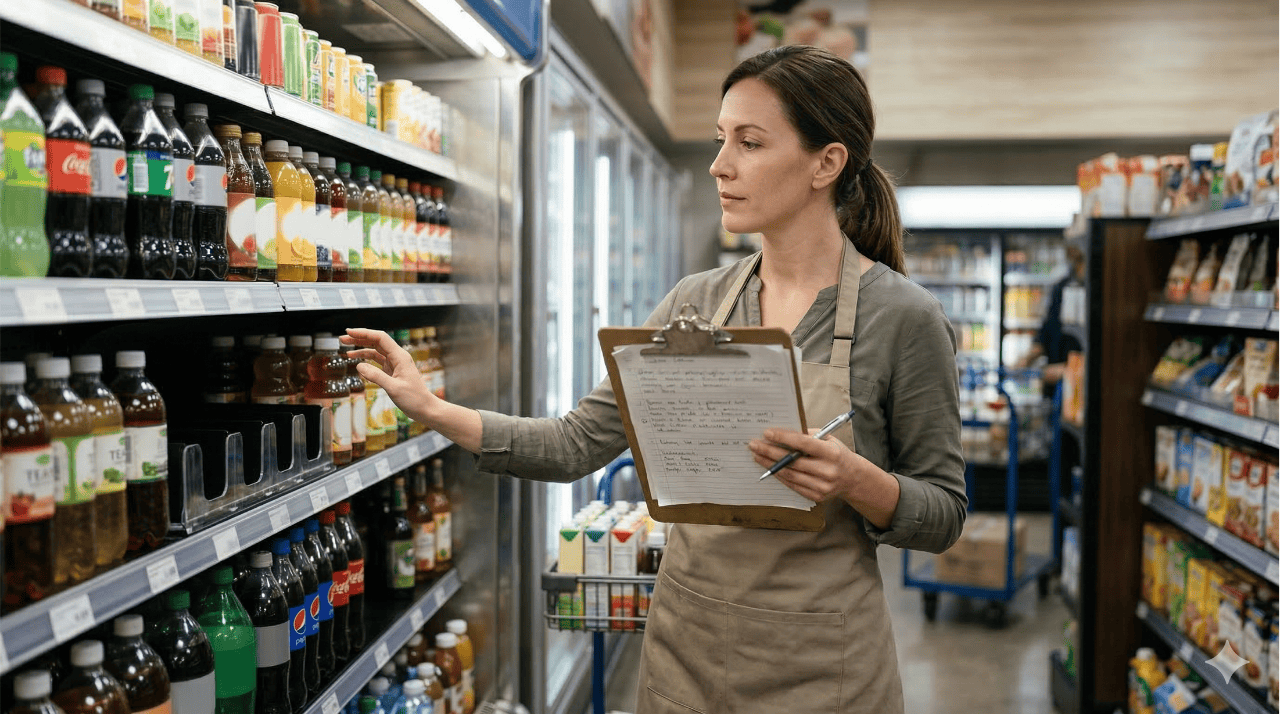
Retail ordering does not start on a computer.
It starts in the aisle.
A store owner walks the floor, checks shelves, opens coolers, looks at what is moving, and notices what is missing. They think about what sold faster than expected, what needs to be restocked before the next rush, and what customers are asking for.
In that moment, they are building their order. Most systems are not designed for that moment.
Where Orders Really Begin
In many retail environments — especially in convenience, liquor, grocery, and foodservice — the ordering process is physical before it is digital. A retailer might walk the store with a clipboard, write quantities next to product names, mark up a printed order guide, take notes on a phone, or mentally track fast-moving items.
By the time they are done, they already know what they want to order. The order is complete. It just is not in a system yet.
The Disconnect Between Reality and Systems
This is where friction begins. After building the order in a way that feels natural, the retailer is often asked to sit down at a computer, log into a portal, search for each item, re-enter quantities, and navigate a structured interface.
From the distributor's perspective, this is efficient. Orders come in clean, structured, and ready for processing. From the retailer's perspective, it is duplicate work. They already did the hard part. Now they are being asked to do it again.
Why Retailers Still Default to Phone, Text, and Paper
Because of this disconnect, many retailers continue to rely on phone calls, text messages, voicemails, photos of handwritten orders, and quick conversations with their sales rep. These methods are not outdated. They are efficient for the customer. They allow retailers to place orders quickly, avoid retyping, communicate in the flow of their day, and get confirmation in real time.
Even when digital tools are available, behavior does not always change. Convenience wins.
The Hidden Assumption Behind Most Systems
Most ordering systems are built around one assumption: that the order should be created inside the system. But in reality, the order is created before the system is ever used.
This is a fundamental mismatch. Systems are designed to capture orders in a structured format. Customers build orders in an unstructured, real-world environment. When those two worlds do not align, friction shows up.
What Customer-First Ordering Actually Looks Like
If the goal is to make ordering easier, the process should start where the customer already is. That means letting retailers build orders however they prefer, accepting orders in multiple formats, reducing the need for re-entry, and removing unnecessary steps.
A customer who has already written an order should not have to type it again just to make the system work. Customer-first does not mean better interfaces. It means less effort.
Why This Matters More Than Ever
Retail environments are getting faster and more demanding. Store owners are managing labor shortages, tighter margins, and higher expectations from their own customers. Every extra minute spent placing an order is time taken away from running the business.
If ordering feels slow or inconvenient, retailers adapt. They delay orders, simplify orders, or shift volume elsewhere. Ease of ordering is no longer a nice-to-have. It directly impacts revenue.
Bridging the Gap Between Behavior and Systems
The opportunity is not to force customers into better systems. It is to design systems that match how customers already work. That means recognizing that orders begin offline, ordering is often unstructured, speed matters more than process, and flexibility matters more than consistency from the customer's perspective.
When systems adapt to behavior instead of forcing behavior to adapt to systems, everything improves. Orders come in faster. Errors decrease. Customers stay engaged.
Final Thought
Retailers are not resisting technology. They are optimizing for what is easiest in their day-to-day workflow.
The businesses that win will not be the ones with the most advanced ordering systems. They will be the ones that reduce effort for the customer. Because in the end, the easiest way to place an order is the one that gets used.
← Back to all articles