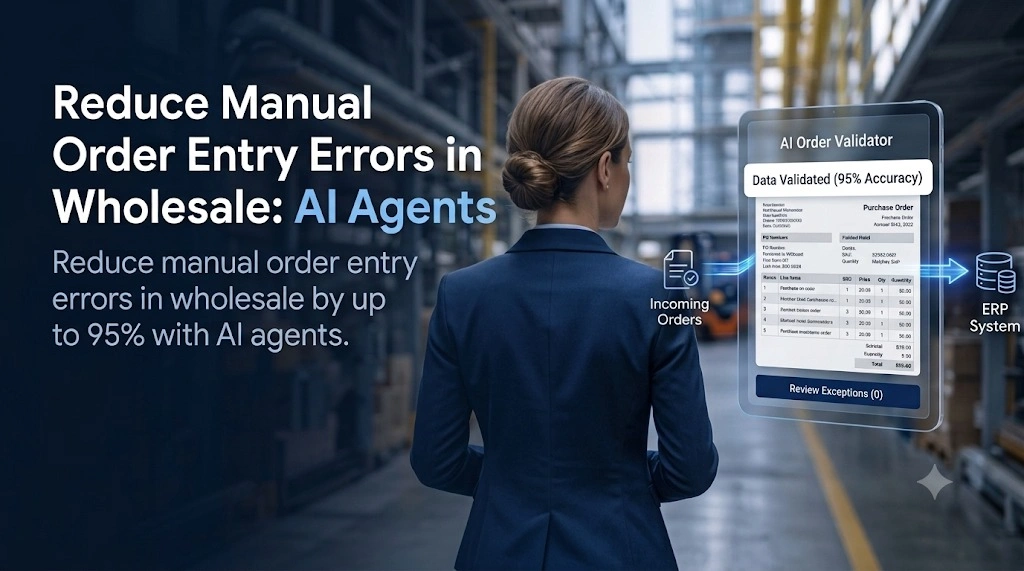
Reducing manual order entry errors in wholesale starts with a simple fact: every order that’s re-typed by hand is an order with a chance to go wrong. A wrong SKU, a transposed quantity, a missed unit of measure. Multiply that by hundreds of orders a week and the mistakes stop being occasional. They become a cost center.
Key takeaways
- Manual order entry errors in wholesale usually come from re-keying orders across email, PDF, EDI, and phone into an ERP or OMS.
- The real cost isn’t the typo. It’s the mis-pick, the chargeback, the rush freight, and the account that quietly stops ordering.
- AI agents remove the re-keying step entirely: they read the order, validate it against your catalog and inventory, flag anything off, and push clean data into your system.
- Distributors who deploy AI agents on their order pipeline report error reductions in the 90 to 95% range within the first quarter, because the agent catches mistakes before they reach the warehouse, not after.
What Manual Order Entry Errors in Wholesale Actually Cost You
Here’s how most wholesale order desks still work: a customer sends a PO by email, a portal upload, a fax, or a phone call. Someone on the order team reads it and types it into the ERP by hand.
- Orders arrive in inconsistent formats, so each one is interpreted differently.
- Staff manually match customer part numbers to internal SKUs, often from memory.
- Quantities, units of measure, and pricing tiers get keyed in under time pressure.
- Nobody catches a mistake until the warehouse pulls the wrong item or the invoice doesn’t match the PO.
Every one of those steps is a place where a manual order entry error in wholesale can slip in. And the downstream cost is bigger than the correction itself:
- Mis-picks trigger returns, re-shipments, and rush freight.
- Pricing errors trigger chargebacks from retail and distribution partners.
- Repeated mistakes on the same account erode trust and push volume to a competitor.
- Order desk staff spend hours a week fixing errors instead of processing new orders.
Why Reducing Order Entry Errors Is Harder Than It Looks
Most wholesale teams already know they have an accuracy problem. Fixing it is where things get stuck, because the team is stuck choosing between two bad options.
The forced tradeoff: speed or accuracy
Order desks are judged on throughput. Slow down to double-check every line item and orders back up. Move fast and errors creep in. Adding a second reviewer helps a little, but it doubles the labor cost per order and still misses mistakes that look plausible on the page, like a quantity that’s off by one digit.
The hidden cost of staying manual
Teams that don’t fix this keep absorbing the same losses on repeat: rework hours, freight overages, chargeback fees, and strained relationships with sales, who has to apologize to the account every time. None of that shows up as a single line item, which is exactly why it’s easy to underestimate and hard to budget against.
How AI Agents Reduce Manual Order Entry Errors in Wholesale
An AI agent removes the re-keying step, which is where most manual order entry errors in wholesale actually originate. Instead of a person reading a PO and typing it in, the agent reads it and enters it, checking it against your data before anything reaches the ERP.
It reads orders in whatever format they arrive
The agent parses email attachments, PDFs, EDI feeds, and portal submissions the same way, pulling line items, quantities, ship-to details, and pricing without a human retyping anything.
It matches and validates against your live catalog
Customer part numbers get matched to your internal SKUs automatically. Quantities and units of measure are checked against your catalog rules, and pricing is checked against the customer’s actual contract or tier, not what a rep remembers from the last order.
It flags anomalies before they become mistakes
If a quantity looks unusually high, a SKU doesn’t exist, or a price doesn’t match the account’s agreement, the agent holds the order for a quick human review instead of letting it pass through. This is the step that catches what a rushed manual review misses.
It syncs clean orders straight into your ERP or OMS
Once an order passes validation, it’s written directly into your system of record. No double entry, no separate spreadsheet, no lag between when the order lands and when the warehouse can see it.
Reduce Manual Order Entry Errors in Wholesale: Before vs. After AI Agents
| Manual Order Entry | AI Agent Order Entry | |
| Time per order | 8 to 15 minutes of manual keying | Under 1 minute, human review only on flagged orders |
| Error rate | Varies widely by team, often several percent of line items | Reduced by 90 to 95% in early deployments |
| Where errors are caught | After the warehouse picks or the invoice goes out | Before the order reaches the ERP |
| Staff time spent | Split between new orders and fixing old mistakes | Focused on flagged exceptions and account issues |
| Scalability | Order volume growth requires more headcount | Order volume growth doesn’t require proportional headcount |
What a 95% Reduction in Order Entry Errors Looks Like Day to Day
A 90 to 95% drop in manual order entry errors doesn’t show up as one dramatic fix. It shows up as a string of things that stop happening: the warehouse stops calling about a SKU that doesn’t exist, the finance team stops writing off chargebacks for pricing mismatches, and the order desk stops spending Friday afternoons untangling Monday’s mistakes.
What Makes AI Agents Different From Basic Order Automation
Not every “automation” tool actually reduces manual order entry errors in wholesale. Here’s where AI agents differ from what most teams already have in place:
- RPA and macros replay the same keystrokes every time. They break the moment an order format changes, and they don’t catch a mistake, they just execute it faster.
- OCR-only tools extract text from a PDF but don’t validate it against your catalog, pricing, or inventory, so a misread quantity still makes it through.
- AI agents read the order, cross-check it against your live product and pricing data, and make a judgment call about whether it needs a human before it ever touches your ERP.
That validation step, checking the order against your actual business rules instead of just transcribing it, is what turns “faster data entry” into fewer mistakes.
How to Start Reducing Manual Order Entry Errors in Wholesale
- Pull your current error rate. Look at return, chargeback, and correction data from the last quarter to see how many orders needed rework.
- Map every channel orders arrive through, including email, EDI, portals, and phone, since each one is a different point of failure.
- Pick one channel or account segment to pilot, rather than rolling out across every order type at once.
- Connect the AI agent to your ERP or OMS so validated orders flow through without manual re-entry.
- Set your review thresholds, deciding which flagged anomalies need a human look before an order is approved.
- Track error rate weekly for the first 90 days to confirm the reduction and expand to additional channels.
Frequently Asked Questions (FAQ’s)
What causes most manual order entry errors in wholesale?
Most errors come from re-keying orders that arrive in inconsistent formats, mismatched customer part numbers, and pricing or quantity mistakes made under time pressure at the order desk.
How much do order entry errors actually cost a distributor?
Beyond the correction itself, costs include rush freight, warehouse mis-pick labor, chargeback fees from retail partners, and lost repeat business from accounts that experience repeated mistakes.
Can AI agents connect to our existing ERP or OMS?
Yes. AI agents are built to sync validated orders directly into the systems distributors already use, rather than requiring a separate platform or a new order entry workflow for staff to learn.
How long does it take to reduce manual order entry errors in wholesale after deploying AI agents?
Most teams see measurable error reduction within the first 30 to 90 days, since the agent starts catching mismatches from the first order it processes.
Do AI agents replace the order desk team?
No. They remove the repetitive re-keying work so staff can focus on flagged exceptions, account issues, and the orders that genuinely need a human judgment call.
← Back to all blogs