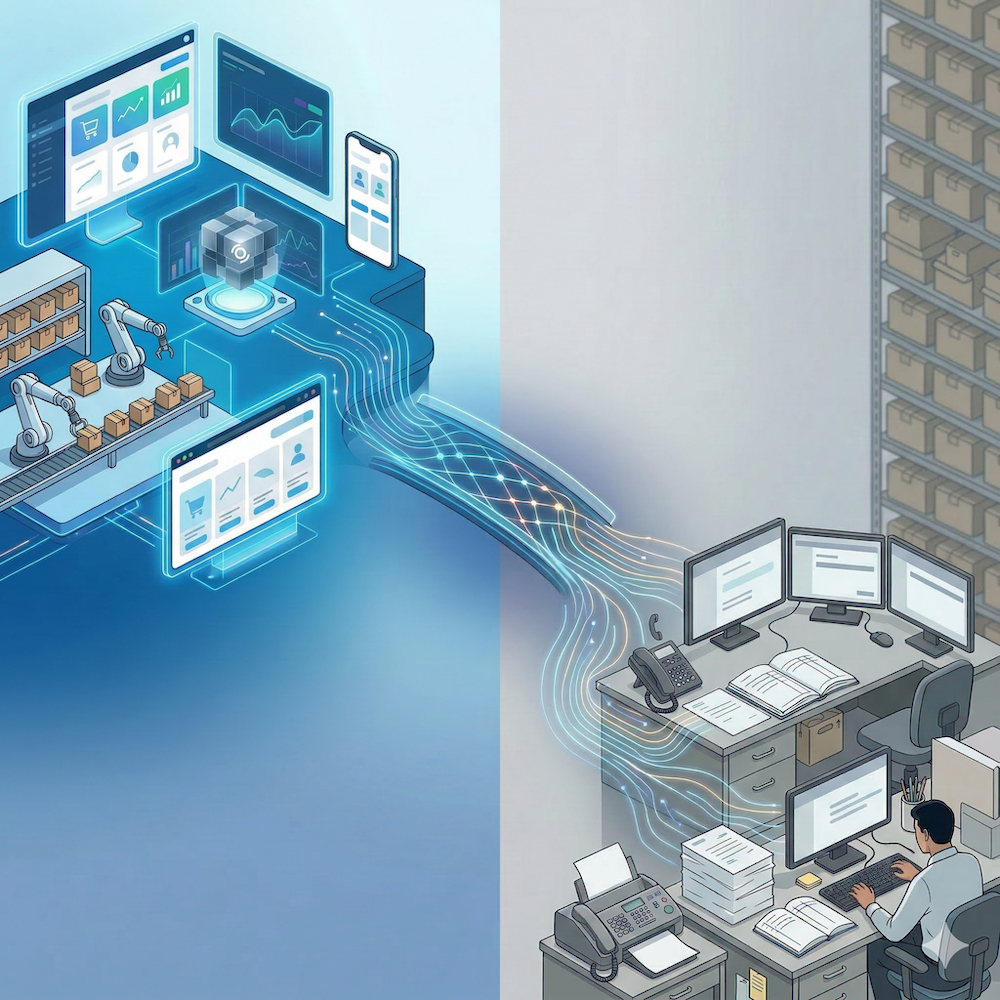
Over the past decade, retail technology has undergone a dramatic transformation. From e-commerce platforms to AI-powered personalization, retailers now operate in a world where software is constantly improving efficiency, driving sales, and shaping customer experiences.
Distribution, however, has followed a very different path.
Despite being the backbone of commerce, many distributors still rely on workflows that have changed little in decades. Orders continue to arrive through phone calls, emails, spreadsheets, and even faxes. Order desks remain staffed with teams manually entering orders, confirming details, checking inventory, and managing exceptions throughout the day.
In many ways, the distribution industry has modernized its infrastructure — warehouse automation, routing systems, and ERP platforms have all improved significantly. But one of the most critical operational layers has remained largely untouched: the workflows surrounding order processing and customer communication.
This gap has created a unique situation. While retailers have embraced tools that automate merchandising, customer engagement, and purchasing experiences, distributors still depend heavily on manual processes to manage the flow of orders coming into their businesses.
Part of the reason is structural. Distributors serve thousands of independent retailers and businesses, many of whom prefer ordering the way they always have. A restaurant owner calling in an order while closing the kitchen, or a convenience store owner texting a last-minute order, isn't thinking about software platforms or digital portals. They are simply trying to get inventory restocked quickly.
For distributors, forcing customers to adopt new ordering interfaces has rarely worked. Instead, most have accepted the operational burden of managing these manual channels internally.
But that reality is beginning to change.
A new generation of automation technologies is emerging that doesn't require retailers to change their behavior. Instead of forcing orders into rigid digital channels, modern automation systems can process orders across the channels distributors already use — phone calls, emails, SMS, and documents — while integrating directly with internal systems.
This shift allows distributors to automate the most labor-intensive parts of their operations without disrupting their customers.
The implications are significant. As automation begins to handle tasks like order capture, validation, substitutions, confirmations, and communication, distributors can reduce operational bottlenecks, lower costs, and scale without continually expanding order desk teams.
In other words, the same technological evolution that transformed retail is finally arriving in distribution.
The distributors that embrace this shift early will be able to operate faster, more efficiently, and with far less operational friction. Those that wait may find themselves competing against organizations that have fundamentally redesigned how their operations run.
Distribution technology may have lagged behind retail for years. But the next wave of innovation is now squarely focused on the systems that keep distributors running every day.
← Back to all articles