Key Takeaways
- Automated order validation wholesale distributors use replaces manual, line-by-line checking with AI agents that confirm SKUs, stock, and pricing before an order ever reaches the ERP.
- Manual keying carries a 2 to 5 percent error rate industry-wide; teams that automate this checking report error rates cut by roughly 95 percent.
- Validation now covers every channel an order arrives on, including PDF attachments, plain-text emails, faxes, SMS, and phone calls.
- Exceptions such as stockouts or price mismatches get resolved by contacting the buyer directly, instead of sitting in a queue until a rep has time.
What Is Automated Order Validation for Wholesale?
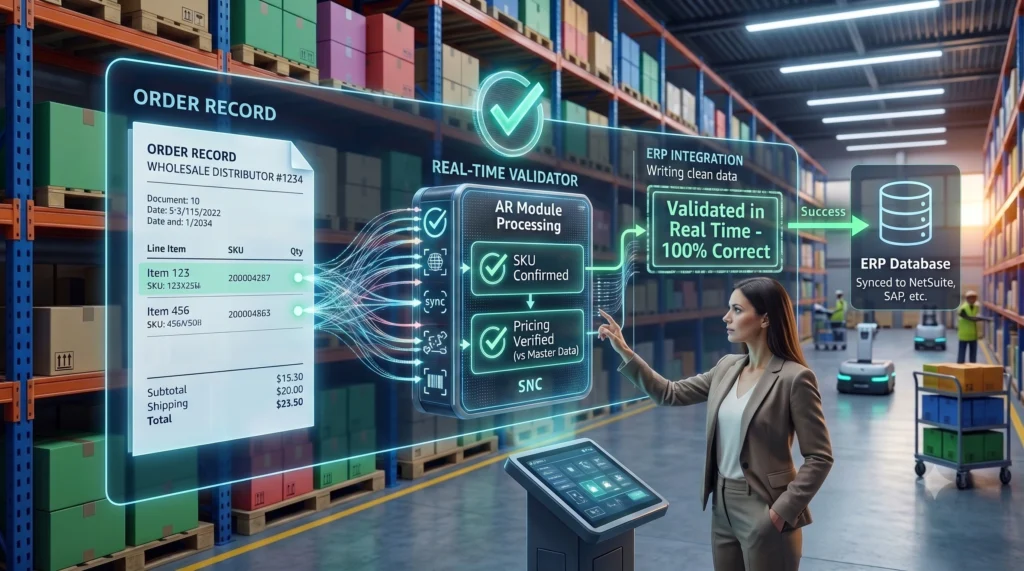
Automated order validation wholesale distributors use is the process of having AI check every incoming order line against live inventory and pricing before that order is keyed into the ERP. In plain terms, instead of a rep manually cross-referencing a purchase order against stock levels and a customer’s contract pricing, an AI agent reads the order, checks it against the system of record, and only passes through lines that are confirmed accurate.
This covers a few consistent checks:
- Confirming each SKU on the order actually exists and matches the buyer’s product
- Verifying the SKU is in stock at the quantity requested
- Matching the price on the order to the buyer’s contract tier or price list
- Flagging any mismatch before it posts, instead of letting it flow through to fulfillment
Why Wholesale Distributors Still Validate Orders by Hand
Most order desks still run this process manually, and it shows. Order desk reps spend a large share of the workday keying line items into the ERP from PDFs, faxes, and emails that were never formatted for a system to read. Industry data on order desk operations puts that figure at roughly 70 percent of a rep’s day going to manual entry rather than the exceptions that actually need a person.
The current way this typically plays out:
- A rep receives an order by email, fax, or phone and re-types every line into the ERP by hand
- Stock and pricing checks happen separately, often in a different screen or spreadsheet
- Morning order spikes create backlogs that push validation later in the day
- Mismatches are caught at fulfillment or invoicing, not before the order is confirmed
That last point is where checking orders automatically makes the most difference for wholesale teams. Catching a pricing error before confirmation costs nothing. Catching it after a truck has shipped costs a credit memo, a return, and a customer who now double-checks every future order.
The Trade-Off Wholesale Teams Have Been Forced to Make
For years, wholesale order desks have had to choose between speed and accuracy. Rush an order through to keep the customer happy, and a mispriced or out-of-stock SKU slips past. Slow down to double-check every line, and the backlog grows, calls go unanswered, and the next order desk hire becomes urgent.
Neither choice is free. Rushing costs margin: order entry mistakes typically run 2 to 4 percent of revenue in return shipping, restocking, and discounted replacement goods. Slowing down costs capacity: reps can only key so many lines per hour, so headcount has to scale in a straight line with order volume.
Automating that checking removes the trade-off entirely, letting verification happen at machine speed while the exceptions, the actual judgment calls, still land with a person.
How Automated Order Validation Works for Wholesale Orders
Real-Time SKU and Inventory Checks
The first check an AI agent runs is whether the SKU on the order exists and is available. It reads the order regardless of format, whether a scanned PDF, a typed email, a fax, or a line item read off a phone call, and matches each product reference against the live catalog. If a buyer orders using their own shorthand or a discontinued item number, the agent resolves it against the current catalog before flagging anything as missing.
Pricing and Contract-Tier Validation
Wholesale pricing is rarely one number per SKU. Distributors run tiered pricing, contract pricing, promotional pricing, and volume breaks, often for the same buyer across different product lines. An AI agent checks the price on the incoming order against the buyer’s specific pricing agreement, not a generic list price, and flags anything that falls outside the expected range.
Automatic Exception Resolution
This is the step most order validation tools skip. Older OCR and document-capture tools stop at flagging a problem for a human to fix. An AI agent built for automated PDF order capture and validation goes further: when it finds a stockout or a pricing mismatch, it contacts the buyer directly by email, text, or a short call to confirm a substitution or an updated price, then writes the resolved line into the ERP. The rep only sees the order once it is already clean.
Automated Order Validation vs. Manual Entry vs. Legacy OCR
| Dimension | Manual Entry | Legacy OCR / IDP Tools | Automated Order Validation |
|---|---|---|---|
| Buyer effort required | None, but slow for the distributor | None, back-office only | None; buyers keep using email, PDF, fax, text, or phone |
| Exception handling | Rep calls or emails the buyer | Flags the error for a human to resolve | AI contacts the buyer directly to confirm a fix |
| Setup time | N/A | Complex template setup per vendor | Live in under 24 hours with pre-built connectors |
| Error rate impact | Baseline 2 to 5 percent | Reduces keying but not judgment errors | Roughly 95 percent reduction reported by distributors |
| Scales with order volume | No, linear with headcount | Partially | Yes, without adding reps |
If you want a deeper breakdown of how these two approaches differ technically, this comparison of AI order processing against traditional OCR walks through the parsing and validation differences in more detail.
How Ordana Helps With Automated Order Validation for Wholesale
Ordana runs automated order validation for wholesale distributors through four purpose-built AI agents that sit on top of the ERP you already use, whether that’s NetSuite, SAP, MS Dynamics 365, Epicor, or another system.
- Ordana Desk parses incoming orders from PDFs, emails, and faxes, checks stock and pricing against the ERP in real time, and auto-resolves missing SKUs or pricing questions directly with the buyer before the order posts. It runs on the same AI agent order desk integration that replaces the manual re-keying step described earlier.
- Ordana Voice handles phone-based ordering around the clock. It’s trained on the full catalog and pricing tiers, takes inbound call orders without a rep on the line, and places outbound calls when an order needs a substitution or price confirmation.
- Ordana Predict looks at a buyer’s ordering history to pre-build their cart before they even reach out, and suggests relevant add-ons based on past buying patterns.
- Ordana Chat lets buyers place orders by text or web chat in their own words, something like “send 5 cases gatorade blue,” and turns that into a structured, validated quote or order.
Together, these agents form a full order management system that validates every order at the point of intake, across every channel a buyer might use, without asking them to change how they order.
What Wholesale Distributors Gain From Automated Order Validation
Ordana’s platform data across live distributor deployments shows a consistent pattern once automated order validation for wholesale operations replaces manual entry:
- 4x orders processed per rep, compared to capacity that scales in a straight line with headcount under manual entry
- Roughly a 95 percent drop in manual order entry errors, down from the 2 to 5 percent error rate typical of manual keying
- Zero unanswered calls during peak periods, compared to an industry baseline of 10 to 15 percent of peak calls going unanswered
- Live deployment in under 24 hours, compared to the 3 to 6 months a typical EDI or portal implementation takes
These are Ordana’s own reported platform benchmarks rather than a single third-party case study, so treat them as a directional target for your evaluation and confirm current figures with Ordana directly before including them in a customer-facing proposal.
Getting Started With Automated Order Validation for Wholesale
Rolling out this kind of validation doesn’t require replacing your ERP or asking buyers to change how they place orders. The typical path looks like this:
- Connect your existing ERP so the AI agent can check live stock and pricing
- Map your catalog and pricing tiers so validation reflects your actual contracts
- Run a live test on one of your messiest recent orders to see how the agent handles it
If you’re comparing order processing software options, the fastest way to evaluate fit is to run that test on a real order rather than a demo script.
Frequently Asked Questions (FAQ’s)
What is automated order validation for wholesale distributors?
It’s the use of AI agents to check every incoming order against live inventory and pricing before the order is keyed into the ERP, so mistakes get caught before fulfillment instead of after.
How does AI validate pricing on wholesale orders?
The agent checks the price on the incoming order against the buyer’s specific contract tier or price list, not a generic list price, and flags anything outside the expected range for resolution.
Can this kind of validation handle orders from PDFs, faxes, and phone calls?
Yes. A properly built system reads orders across every channel a buyer uses, including PDF attachments, plain-text emails, faxes, SMS, and inbound phone calls, and validates all of them the same way.
How long does deployment typically take for wholesale distributors?
With pre-built ERP connectors, distributors can be live in under 24 hours, compared to the 3 to 6 month timeline typical of EDI or B2B portal implementations.
Does this replace my ERP?
No. It sits on top of your existing ERP and writes clean, validated order lines into it. Your ERP remains the system of record.
← Back to all blogs