Digital vs. Human Is the Wrong Debate in Distribution
For years, distributors have debated how much of the customer experience should become digital.
Should customers order through ecommerce instead of calling? Should sales representatives continue taking orders? Should customer service remain highly personal, or should more interactions move to self-service? How much of the traditional relationship model should distributors preserve as technology improves?
Those are reasonable questions, but they increasingly start from the wrong premise.
The real choice is not digital versus human.
It is routine versus complex.
A routine transaction does not necessarily need a person simply because it arrives through a phone call. And a complicated interaction does not suddenly stop needing human judgment because the customer started it on a website.
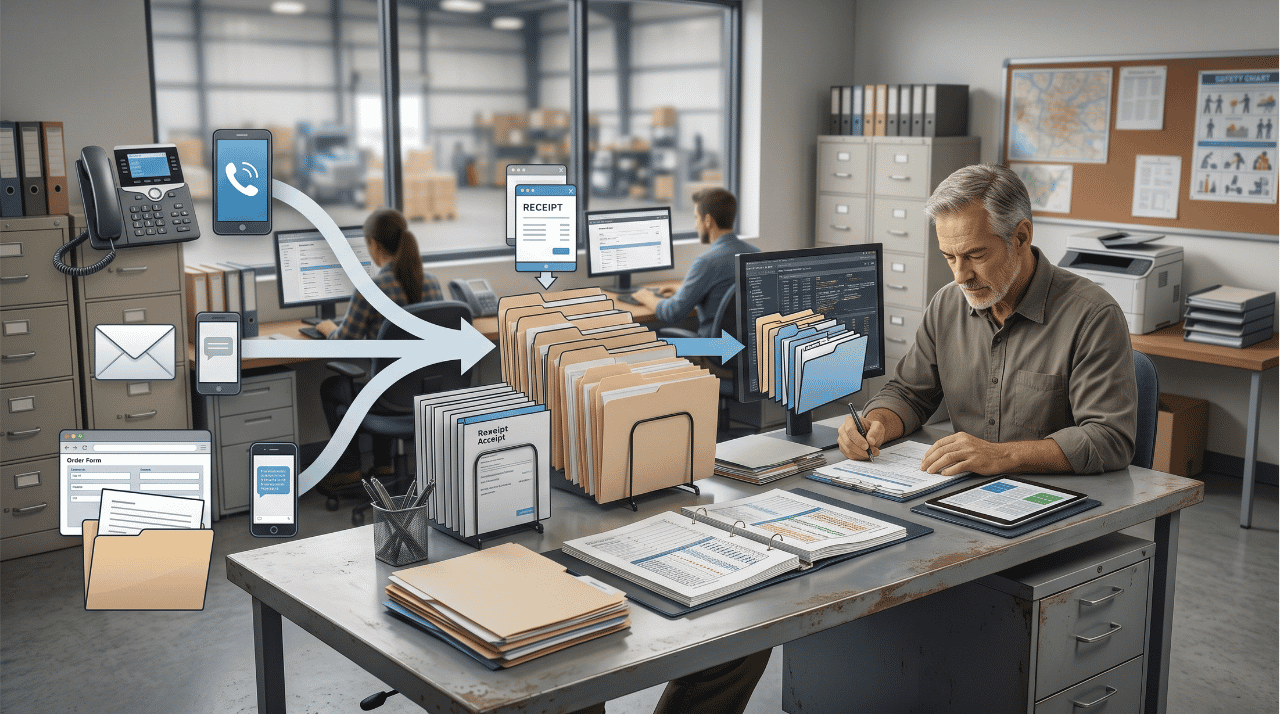
As AI becomes capable of understanding and acting across phone, email, text, documents, and digital channels, the channel itself becomes less important. What matters is the nature of the interaction and whether a person can actually add value.
That changes how distributors should think about both automation and customer service.
For most distributors, the operating model has been closely tied to the way an order arrives.
An ecommerce order is automated because the customer entered the information directly into a system. An EDI order is automated because structured data passes between two systems.
A phone call, on the other hand, requires a person. So does an email, a text message, a voicemail, or a fax.
The result is that two customers placing essentially the same order can create completely different amounts of work for the distributor.
One customer orders 12 cases through a portal and the transaction flows directly into the system.
Another customer calls and asks for those same 12 cases, and suddenly a person is required to answer the phone, identify the customer, understand the products, confirm quantities, enter the order, and move it forward.
From the customer’s perspective, the transaction may be identical.
The operational difference exists primarily because of the channel.
For years, distributors tried to solve that problem by moving customers toward digital ordering. Portals, ecommerce sites, apps, and EDI all created ways to turn unstructured customer interactions into structured transactions.
Those technologies remain valuable.
But they also created an assumption that automation requires customers to change how they behave.
AI is beginning to challenge that assumption.
Consider a customer who calls every Tuesday morning and places essentially the same replenishment order.
There may be a relationship behind that phone call, but there may be very little relationship required to execute the transaction itself.
The customer provides the products and quantities. Availability is checked. Maybe there is a common substitution. The order is confirmed and submitted.
Historically, a person had to handle that interaction because computers could not reliably understand a natural conversation and complete the work behind it.
That limitation is disappearing.
The same is true for email. A customer should not necessarily need a person simply because they typed an order into the body of a message instead of into an ecommerce form.
The same applies to text messages and documents.
This creates an important distinction.
Digital does not have to describe the customer’s behavior anymore. It can describe what happens behind the interaction.
The customer can continue calling the same number, sending the same email, or using the same ordering workflow they have used for years. The distributor can automate more of what happens after that interaction without forcing the customer into a new process.
That is very different from the traditional digital transformation model.
The reverse is also true.
A customer may start an interaction through ecommerce, but that does not mean the entire experience should remain self-service.
Imagine an account that suddenly places an order five times larger than normal. A buyer repeatedly searches for a product the distributor does not carry. A customer begins abandoning orders because an important item is unavailable. A pricing issue is preventing a significant transaction from being completed.
Those interactions started digitally.
But a person may be exactly what the situation needs.
A salesperson may recognize an expansion opportunity. A customer service representative may resolve a complicated issue. Someone with account knowledge may understand why the customer’s purchasing pattern changed.
This is why simply pushing customers toward digital channels can miss the larger opportunity.
Sometimes the best digital experience is knowing exactly when to introduce a human.
A more useful way to design the customer experience is to separate interactions by complexity and value rather than by channel.
Routine interactions should increasingly be handled automatically wherever they originate.
A standard replenishment order is routine whether it arrives through a portal or a phone call. A known substitution can often be resolved regardless of whether the request came through email or text. A basic order status question should not necessarily require customer service simply because someone called to ask it.
More complex interactions should move toward people.
That could include an unusual pricing issue, a sensitive customer problem, an ambiguous request, a major change in buying behavior, or an opportunity that requires commercial judgment.
This creates a much more flexible operating model.
The objective is no longer to convince every customer to become digital.
The objective is to make every interaction efficient while preserving human attention for the moments where it actually improves the outcome.
One reason distributors are understandably cautious about automation is that relationships matter enormously in wholesale distribution.
A salesperson may have worked with an account for 15 years. A customer may call a particular CSR because that person understands exactly how their business works. Those relationships are real competitive assets.
The mistake is assuming that preserving the relationship requires keeping people involved in every transaction.
In many cases, the opposite may be true.
If a salesperson spends hours receiving routine orders, checking availability, answering repetitive questions, or re-entering information, that is time they are not spending understanding customers, identifying opportunities, solving problems, or expanding accounts.
The relationship is not strengthened simply because the salesperson typed the order.
It is strengthened when the salesperson does something the customer values.
As automation handles more routine work, the human side of distribution can become more human, not less.
People can spend more time advising customers, solving difficult problems, building trust, and recognizing opportunities that a transactional workflow would never uncover.
The goal is not to remove relationships from distribution.
It is to stop confusing transaction processing with relationship building.
There is another reason the digital-versus-human debate is becoming outdated.
Customers increasingly expect both.
They want simple things to be easy. They do not want to wait on hold to check an order status or place the same replenishment order they place every week.
But when something is genuinely wrong or complicated, they want someone capable of helping them.
Historically, businesses often forced customers into one experience or the other.
Digital-first businesses made routine transactions easy but sometimes made human assistance frustrating to reach. Relationship-driven businesses provided excellent personal service but required people for interactions that should have taken seconds.
The better model combines both.
Automation should remove unnecessary effort.
People should provide judgment, empathy, creativity, and expertise when those qualities improve the result.
Customers should not have to decide whether they are dealing with a “digital distributor” or a “relationship distributor.”
The best distributor should be both.
This may ultimately be one of the biggest changes AI brings to distribution.
For decades, distributors built separate workflows around separate channels.
Phone orders followed one process. Emails followed another. Ecommerce followed another. EDI operated largely on its own.
AI increasingly makes it possible to understand customer intent across those channels and route the work based on what needs to happen next.
That means the customer’s preferred channel can remain intact while the operational process behind it becomes far more consistent.
A customer who likes calling can keep calling.
A customer who prefers email can keep emailing.
Another customer can use ecommerce.
The distributor does not necessarily need to force all three into the same front-end experience in order to create efficiency behind the scenes.
Instead, the business can begin making a different decision:
Does this interaction require a person?
That question is far more important than asking whether the interaction began digitally.
Distribution has spent years debating how customers should interact with distributors.
Digital or human. Self-service or relationship-driven. Ecommerce or salesperson.
Those distinctions are becoming less useful.
The better question is what kind of interaction is taking place.
If the request is routine, technology should increasingly be able to handle it regardless of whether it arrives through a website, phone call, email, text message, or document.
If the interaction is complex, commercially important, sensitive, or ambiguous, a person should be able to step in regardless of where the interaction began.
That is not digital-first.
It is not human-first.
It is customer-first.
The future of distribution will not be defined by choosing between technology and people.
It will be defined by getting much better at knowing when each one should be involved.
Ordana handles the transactions so your team can focus on the interactions that actually require people — without asking your customers to change how they order.