For much of the distribution industry’s history, growth followed a fairly predictable formula. More customers meant more orders. More orders meant more calls, more emails, more coordination, and eventually more people required to manage the additional volume.
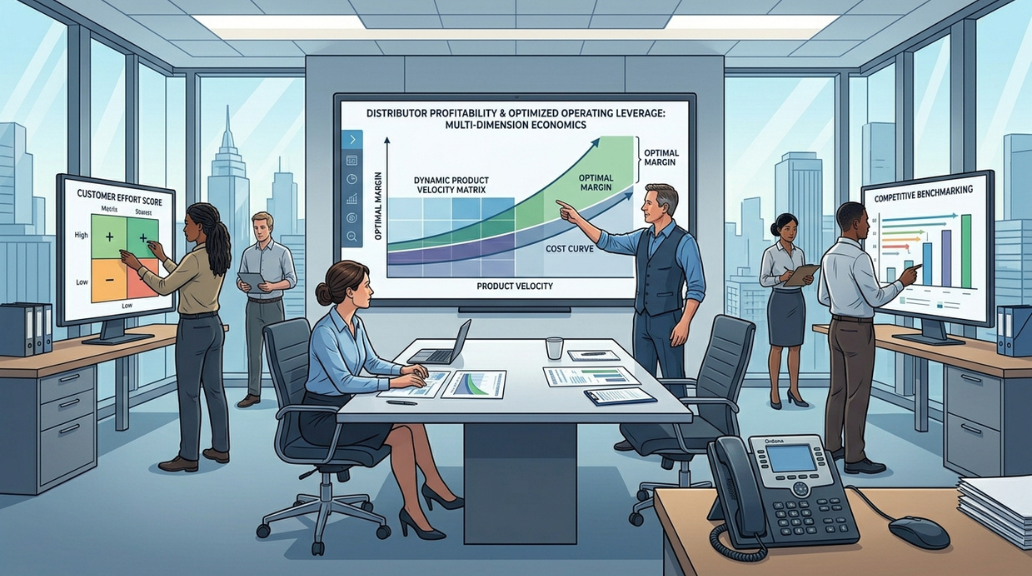
That model worked because the economics were understood. If the business grew, the operating infrastructure grew with it. But technology, and particularly AI, is beginning to change that relationship. For the first time, distributors have an opportunity to grow revenue without requiring operating costs and organizational complexity to increase at the same rate.
That shift could fundamentally change the economics of growth in distribution.
Growth Has Traditionally Created More Work
Revenue growth is obviously good for a business, but growth creates operational consequences that are easy to underestimate. A distributor adding customers is not simply shipping more cases or pallets. Every additional account creates more orders, questions, changes, calls, emails, exceptions, confirmations, and administrative work.
Eventually, capacity becomes constrained. A sales representative cannot handle another set of accounts. The order desk becomes overloaded during peak periods. Customer service response times begin to increase. Managers spend more time coordinating people and resolving issues.
The traditional solution has been to add capacity. Another customer service representative. Another coordinator. Another salesperson. More operational support. There is nothing inherently wrong with that model, but it means revenue and operating expense often remain closely connected. As the business gets larger, the organization required to support it gets larger as well.
The New Opportunity Is Operating Leverage
The next generation of distribution businesses will have an opportunity to break some of that relationship. If repetitive operational work can increasingly be handled by technology, the same organization can support significantly more activity. More orders can be processed without creating the same increase in order-entry work. More customer interactions can be handled without creating longer queues. Demand spikes can be absorbed without building permanent capacity around the busiest few hours of the week.
This is not primarily a story about reducing today’s workforce. It is about increasing the capacity of the business. A company growing 20% should not automatically assume it needs 20% more operational resources to support that growth. The question becomes how much additional volume the existing organization can absorb before additional capacity is actually required.
That is operating leverage, and AI has the potential to make it available in parts of distribution where historically it has been difficult to achieve.
The Role of People Becomes More Valuable
This shift also changes what employees spend their time doing. A sales representative who spends hours receiving routine orders, entering information, or responding to repetitive requests has less time to visit customers, identify new opportunities, and grow accounts. A customer service employee focused on routine order status questions has less capacity to resolve complex issues where human judgment genuinely matters.
As routine work is absorbed by technology, people do not become less important. Their time becomes more valuable. The objective is not to remove the human relationships that have always been central to distribution. It is to stop consuming those relationships with work that does not require them.
That creates a different growth model. Existing teams can support more customers while spending a greater percentage of their time on activities that actually contribute to growth.
Better Economics Create More Options
Operating leverage has implications far beyond labor efficiency. When revenue can grow faster than operating expenses, businesses generate more resources to reinvest. Those resources can fund geographic expansion, new product categories, acquisitions, stronger sales teams, better customer experiences, warehouse improvements, and new technology.
It creates a compounding effect. Efficiency produces capacity. Capacity supports growth. Growth creates additional resources to invest in the business. This is why the conversation around AI in distribution should ultimately be much larger than automation or cost savings. The more important question is whether technology can change the economics of how the company grows.
A business that can support substantially more revenue with the same operational foundation has a fundamentally different growth profile from one that must continually add complexity as volume increases.
Growth Without Complexity Becomes the Advantage
There is another important benefit to this model. Organizations do not just become more expensive as they grow. They often become more complicated. More people create more handoffs. More processes create more coordination. More systems create more opportunities for information to get lost between them. What worked naturally at $50 million in revenue may become significantly harder at $100 million or $250 million.
The best technology investments should allow businesses to increase scale without introducing the same level of organizational complexity. That may ultimately become one of the biggest competitive advantages available to distributors. Two companies could grow at the same rate while building very different businesses underneath that growth. One becomes progressively more complicated and expensive to operate. The other becomes increasingly leveraged. Over time, their economics look very different.
The Growth Question Is Changing
For distribution leaders, this creates a different question when planning for the next several years. Instead of simply asking, “What resources will we need if we grow 25%?” leaders can begin asking, “How much more business could our current organization support if we redesigned where the work happens?”
That is a subtle shift, but an important one. Growth no longer has to mean replicating today’s operating model at a larger scale. It can mean building an organization capable of doing significantly more with the resources, relationships, and expertise it already has.
Final Thought
The economics of distribution have historically tied growth closely to operating capacity. More business created more work, and more work required more resources. That relationship is beginning to change.
AI and automation are creating an opportunity for distributors to increase the productive capacity of their organizations without increasing complexity at the same pace. The result is not simply lower costs. It is a business that can grow differently.
The distributors that understand this shift will not necessarily use technology to become smaller. They will use it to become much bigger without having to become equally more complicated.
← Back to all articles