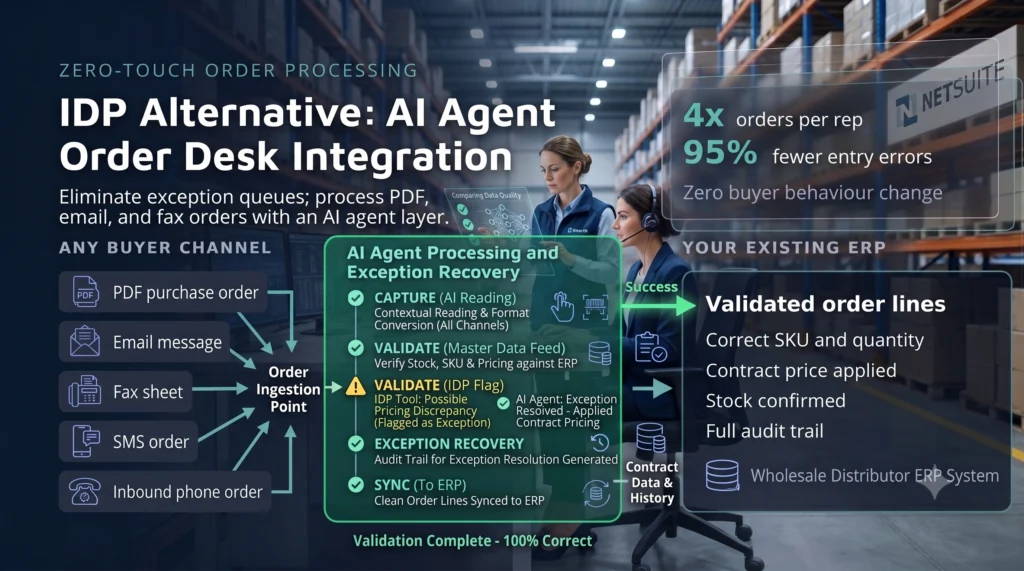
Intelligent Document Processing alternative for order entry is what wholesale distributors start searching for the moment their OCR tool hits its ceiling. IDP software reads a PDF, a fax, or an email and turns it into structured fields. It does that part well. What it does not do is finish the order. The moment a SKU is out of stock, a price does not match the contract, or a buyer’s handwriting confuses the model, the software stops and hands the problem back to a person. That gap between capture and completion is why so many order desks that adopted IDP still run on manual labor during every exception, which on a high-volume desk is most of the day.
Key takeaways
- IDP tools automate document capture but stop at flagging exceptions, leaving stockouts, price mismatches, and low-confidence fields for a human to resolve
- Order entry errors from manual exception handling cost distributors an estimated 2 to 4 percent in margin through returns, restocking, and discounted replacements
- An intelligent document processing alternative for order entry needs to close the loop: read the order, check stock, resolve the exception with the buyer, and write clean data to the ERP without a person in the middle
- Ordana’s four-agent system (Desk, Voice, Predict, Chat) is built as a closed-loop order entry alternative, targeting a 4x increase in orders processed per rep and a 95 percent drop in entry errors
- Deployment for an AI agent layer like Ordana is measured in hours, not the 3 to 6 month timeline typical of EDI or portal onboarding
What Is an Intelligent Document Processing Alternative for Order Entry?
An intelligent document processing alternative for order entry is a system that takes over the full order lifecycle, not just the scanning step. IDP itself is optical character recognition paired with machine learning: it lifts text and line items out of unstructured documents like PDFs and faxes and maps them to fields your ERP expects. That is useful, but it is a back-office extraction tool. It was never built to talk to a buyer, confirm a substitution, or re-price a line item on the fly.
- IDP: captures and structures data, then flags anything it cannot resolve with confidence
- An alternative for order entry: captures the data and finishes the transaction, including the parts IDP treats as exceptions
- The distinction matters because on a real order desk, exceptions are not the edge case. They are the daily grind.
The Current Way Wholesale Distributors Handle Order Entry Without an IDP Alternative
Most mid-market and enterprise distributors run order entry the same way today. Orders come in across PDF attachments, plain-text emails, faxes, SMS, and phone calls. A rep, or an IDP tool sitting in front of a rep, converts that mess into ERP-ready lines. IDP is typically bolted onto whatever order management system the distributor already runs, rather than replacing the manual steps inside it. The work looks automated until something breaks.
- Reps at these desks report spending as much as 70 percent of their morning keying line items into the ERP by hand
- Morning order spikes create a backlog that IDP’s flagging behavior does not clear on its own
- Every fax, PDF, or garbled email still routes to a person once the software’s confidence score drops
Where Intelligent Document Processing Order Entry Tools Stop Short
IDP’s job ends at extraction. Once a line item is flagged, whether that is a missing SKU, a stock shortfall, or a price that does not match the customer’s contract, the software’s role is done. A rep has to open the order, call or email the buyer, confirm the fix, and re-key the correction. You can read more about how that captured data actually reaches the ERP in our breakdown of automated PDF order capture into your ERP, and how the two categories differ from the ground up in our full comparison of AI order processing and OCR.
Why Wholesale Distributors Need an Intelligent Document Processing Alternative for Order Entry
The Forced Tradeoff Between OCR Automation and Exception Handling
IDP forces a choice buyers should not have to make. Either accept partial automation and keep a rep on standby for every exception, or skip IDP and key every order by hand for consistency. Neither option removes the labor. It only moves where the labor sits.
Negative Consequences of Staying on IDP-Only Order Entry
- Entry errors that slip past a rushed manual fix cost distributors an estimated 2 to 4 percent in margin, through return shipping, restocking fees, and discounted replacement goods
- Order desks report losing 10 to 15 percent of peak-hour calls simply because no one was free to answer while resolving an IDP exception
- Onboarding a new IDP template per vendor or document format can take months, during which the old manual process has to keep running in parallel
For a deeper look at what these errors cost a distribution team specifically, see reduce manual order entry errors in wholesale distribution.
See it on your own orders
- Curious what your own order desk is losing to manual exception handling? Ordana Desk resolves exceptions instead of just flagging them.
Intelligent Document Processing Alternative for Order Entry: Feature-by-Feature Comparison
The table below lines up the three approaches distributors typically compare: a traditional B2B e-commerce portal, a legacy OCR or IDP tool, and an AI agent platform built as a true order entry alternative.
| Dimension | Traditional B2B Portals | Legacy OCR / IDP Tools | Ordana AI Platform |
|---|---|---|---|
| Buyer adoption friction | High: buyers must learn a new portal | N/A: back-office tool only | Zero: buyers keep using email, PDF, fax, text, or phone |
| Exception resolution | Manual: buyers or reps fix errors themselves | Manual: low-confidence fields are flagged for a human | Autonomous: the agent contacts the buyer to confirm a substitution or price |
| Setup and integration | 3 to 6 months to implement | Complex: a template per vendor or document type | Live in under 24 hours through pre-built connectors |
| Average order value growth | Passive: depends on buyers browsing | None | Active: cart pre-building suggests contextual add-ons |
Full order processing software category context, including where portals and IDP tools tend to fit best, is covered in our guide to order processing software for wholesale distributors.
How Ordana Delivers an Intelligent Document Processing Alternative for Order Entry
Ordana was built specifically to close the gap IDP leaves open. Instead of one tool that stops at extraction, Ordana runs four specialized agents that split the order entry lifecycle, so nothing lands back on a rep’s desk unresolved.
Ordana Desk: Closing the Exception Gap IDP Leaves Open
Ordana Desk parses PDFs, emails, and faxes the same way an IDP tool does, then goes further. It checks live stock in your ERP, and when a SKU is missing or a price does not match, it contacts the buyer directly by email or SMS to confirm a fix before syncing the clean, validated order line. That closed loop is what separates true AI agent order desk integration from document capture alone.
Ordana Voice: Extending the Alternative to Phone Orders
Not every buyer emails or faxes. Ordana Voice handles inbound call orders 24/7, trained on your catalog and pricing tiers, and can place outbound calls to resolve the same exceptions Ordana Desk flags, closing the loop on channels IDP never touched in the first place.
Ordana Predict: Turning Order Entry Into an AOV Lever
IDP has no answer for growing order size, because it only processes what a buyer already sent. Ordana Predict analyzes buying history to pre-build carts before a buyer even reaches out, and suggests contextual add-ons that IDP-based workflows simply cannot generate.
Ordana Chat: Conversational Order Entry for Buyers Who Text
Some buyers just want to text “send 5 cases gatorade blue” and be done. Ordana Chat interprets that kind of unstructured input over SMS and web chat and turns it into a validated quote or order on the spot, no portal login required.
Quantified Benefits of Switching to an Intelligent Document Processing Alternative for Order Entry
These are Ordana’s published target benchmarks based on deployments with wholesale distribution customers. Treat them as a starting point for your own ROI case, and confirm current figures with your Ordana account team before quoting them externally.
- 4x increase in orders processed per rep, versus linear scaling with headcount
- 95 percent reduction in entry errors, versus a 2 to 5 percent manual keying error rate industry-wide
- Zero unanswered calls at peak volume, versus an estimated 10 to 15 percent of calls lost today
- Live deployment in under 24 hours, versus 3 to 6 months for typical EDI or portal onboarding
Test it on a real order
- Ready to see the numbers on your own order volume? Visit Ordana’s AI order desk platform to get a live test on one of your messiest sample orders.
How to Evaluate an Intelligent Document Processing Alternative for Order Entry
Two roles usually drive this decision, and they are evaluating different things. A VP or Director of Operations wants labor leverage without disrupting how buyers already order. A CFO wants a payback period under three months and a margin case that holds up in a board deck. When you compare vendors, score each one on:
- Whether exceptions get resolved autonomously or just flagged for a human
- How long implementation actually takes, in writing, not in a sales deck
- Whether buyers have to change how they place orders at all
- Whether the tool creates any upside, like average order value growth, or only prevents downside
See how the full platform fits together at Ordana’s AI order desk platform.
Frequently Asked Questions (FAQ’s)
Is an intelligent document processing alternative for order entry the same thing as OCR software?
No. OCR and IDP extract and structure data from documents. An order entry alternative like Ordana takes the extracted data and completes the transaction, including resolving stockouts and pricing exceptions directly with the buyer.
How is an IDP alternative for order entry different from a B2B portal?
A portal asks buyers to change their behavior and log into a new system. An IDP alternative built on AI agents keeps buyers on the channels they already use, including email, PDF, fax, SMS, and phone.
What does IDP fail to handle in order entry?
IDP flags low-confidence fields, missing SKUs, and price mismatches for a human to fix. It does not contact the buyer, confirm a substitution, or re-price and re-submit the order on its own.
How long does it take to deploy an AI agent alternative to IDP?
Ordana’s pre-built ERP connectors are designed to go live in under 24 hours, compared with the 3 to 6 month implementation timelines typical of EDI or portal projects.
Which ERPs does an IDP alternative like Ordana support?
Ordana is designed to work with both legacy and modern cloud ERPs, including NetSuite, SAP, Microsoft Dynamics 365, Epicor, QuickBooks Enterprise, Produce Pro, and Encompass.
← Back to all blogs